TapClick and drag to look around. PinchUse your mouse scroll wheel to zoom in and out. You can navigate the virtual spaces by:
Touch and hold an object touchpoint to read its label. Click on an object touchpoint icon to learn more about how the object was used. Some objects have sound or video.
Open or close the Stop Details pane by clicking the ICON in the top left of the header.
First Floor


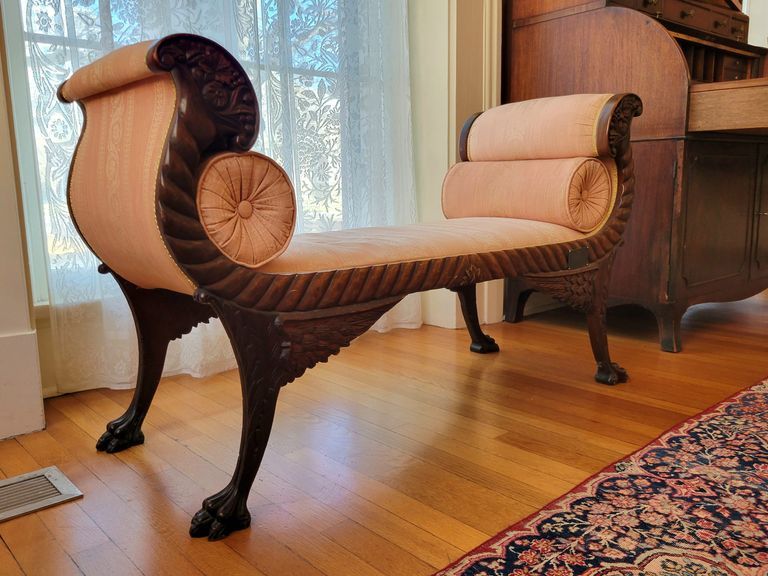
Made in America, ca. 1890, this Empire style mahogany window bench features swept arms carved with a cornucopia of fruit. The skirt rail and bolsters are gadrooned (spiral carved), and the intricately detailed legs are outswept with carved paw feet.
This week we look at the Empire Revival mahogany window bench that sits by the northeast window in the Front Parlor of the Neill-Cochran House Museum. Made in America, ca. 1890, the bench features swept arms carved with a cornucopia of fruit. The skirt rail and bolsters are gadrooned (spiral carved), and the intricately detailed legs are outswept with carved paw feet. This window bench was gifted to the NCHM by Robert Maxey and bears a plaque with the inscription, “From the Home of T.S. Maxey.” Thomas Sheldon Maxey (1846-1921), Robert’s father, was a veteran of the Confederate States Army and a United States District Judge of the Western District of Texas, appointed by President Grover Cleveland. A Democrat and a Mason, Judge Maxey presided over a number of notable cases including the embezzlement trial of Sydney Porter (O. Henry) in Austin, Texas. You can see all the storied artifacts on display at the NCHM, Wed-Sun, 11-4pm. American, ca. 1890. Empire Revival mahogany window bench with swept arms varved with a cornucopia of fruit. Features bolsterers and a gadrooned (spiral carving) skirt rail and out swept legs with paw feet. Gift of Mrs. Robert Maxey


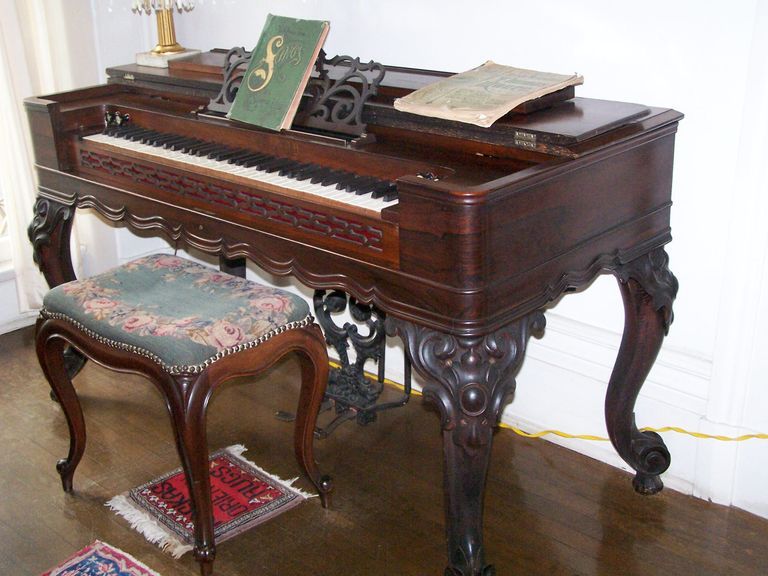
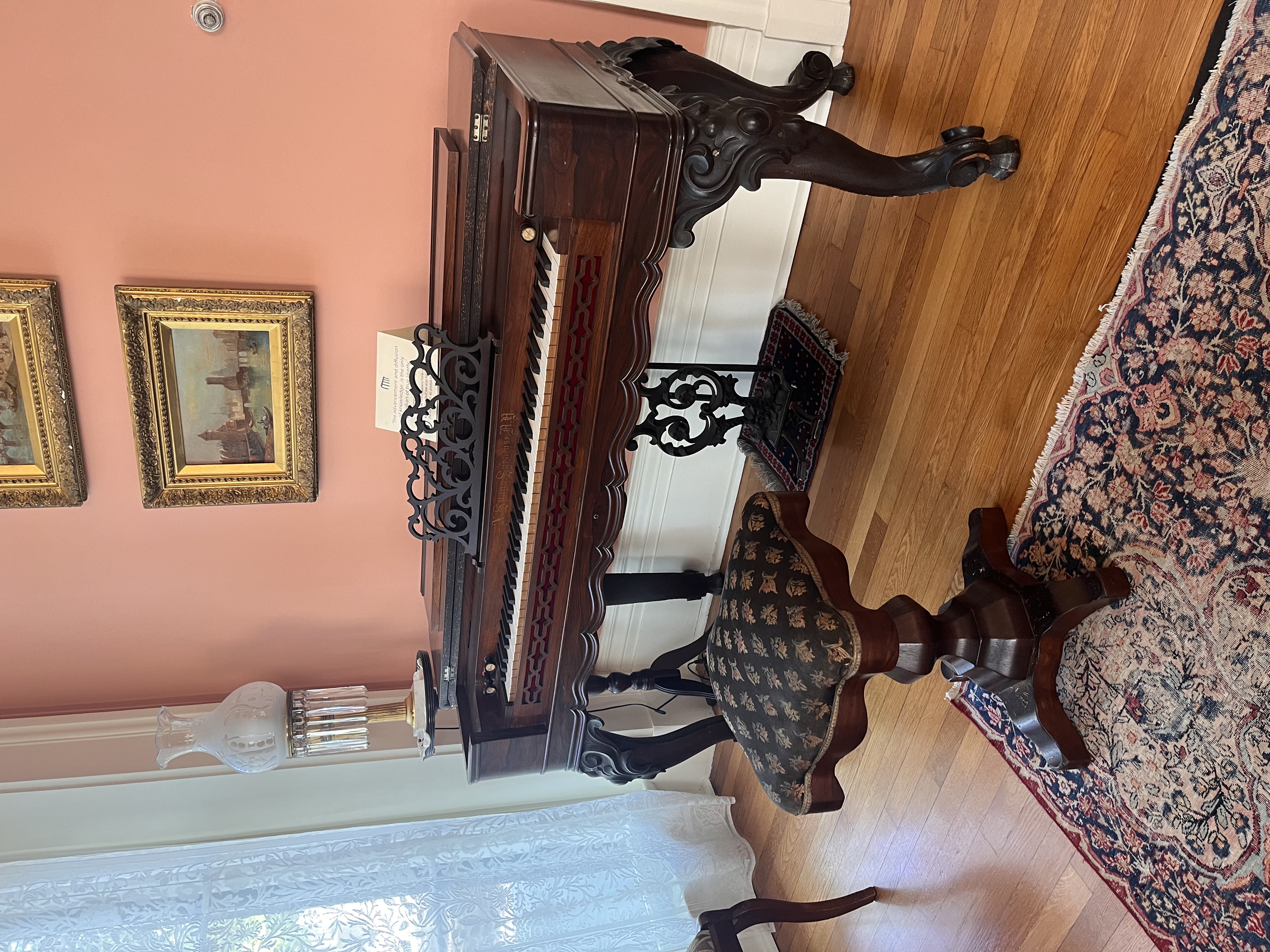
The melodeon is an American invention from the first half of the 19th century. Although melodeons were very popular before and during the Civil War era, they are seldom seen today. Housed in a piano-like case, a melodeon is a small reed organ with a five or six octave keyboard. Back in its heyday, Americans preferred the melodeon over the piano for its durability, lower price, and the advantage of seldom needing maintenance and tuning.
In the southeast corner of the NCHM Front Parlor is a musical instrument called a melodeon. A melodeon is a type of reed organ that generates sound by moving air over internal reeds using a foot-operated bellows. Unlike a piano where the foot pedals modulate the sound, on a melodeon the pedals must be operated to create any sound at all. In this way, the melodeon has more in common with an accordion than a piano. Although the melodeon does not have the subtlety of a piano, it had a great selling point for Victorian households outside of major urban centers: it never needed to be tuned. American, c. 1860. Victorian Rocco Revival melodeon with rosewood case cast iron knees, and walnut legs. Melodeons were reed organs with pedals and bellows and as a result required little maintenance or tuning. Melodeons were very popular during antebellum and reconstruction eras, particularly outside of large metropolitan cities. Gift of Mrs. Gordon West


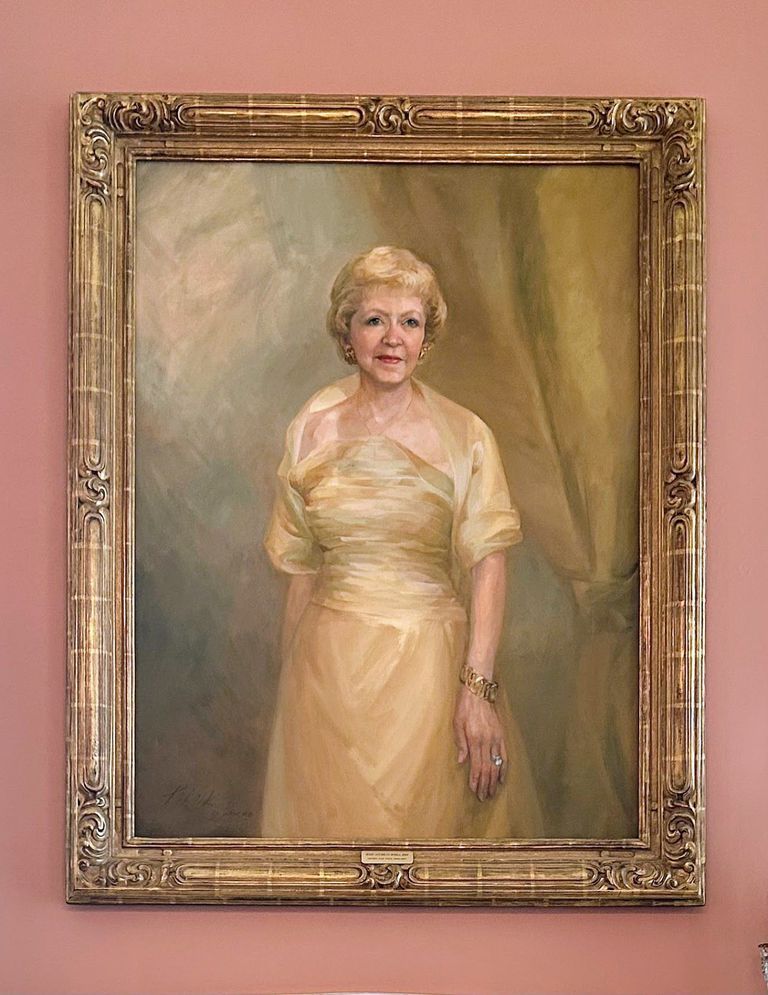
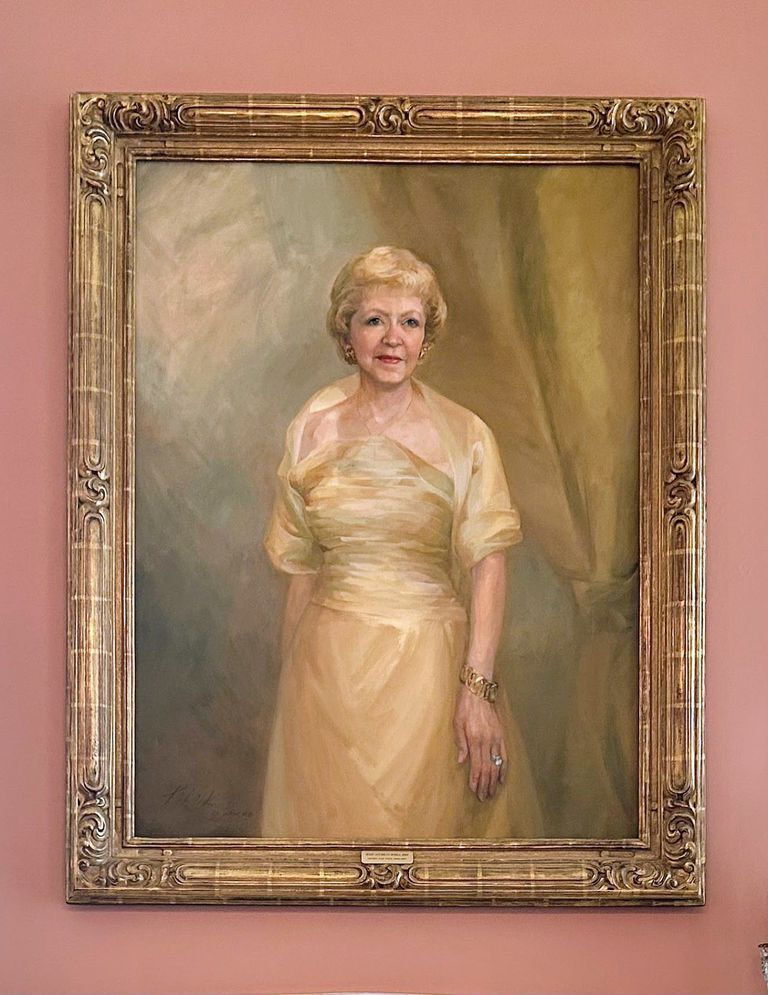
Above the fireplace mantle in the Neill-Cochran House Museum Front Parlor is a portrait of Mary Cochran Bohls painted in 2009 by Kay Polk (1943-2017). Bohls is the granddaughter of Judge Thomas and Bessie Cochran, the original Cochran owners. She has remained closely connected to the NCHM over the years and has helped to make the Museum such a welcoming place.
Above the fireplace mantle in the Neill-Cochran House Museum Front Parlor is a portrait of Mary Cochran Bohls painted in 2009 by Kay Polk (1943-2017). It is an oil painting on canvas with a gilded frame. Polk was a nationally-known portrait artist based out of Dallas, Texas. The portrait was a gift from Dr. and Mrs. Richard Treadway. Mary Cochran Bohls is the granddaughter of Judge Thomas and Bessie Cochran, the original Cochran owners. Today, November 11th, 2022, is Mary's 96th birthday. Earlier this week Mary joined us at the Museum for the NCSDA-TX Board of Managers Meeting and the Dames gathered in the parlor to wish her a happy birthday. This portrait of Mary Cochran Bohls is one of our favorite artifacts in the Museum, and Mary's ongoing connection to the NCHM helps make it a vibrant and loving place. You can see this special artwork, and all of our precious artifacts, Wed-Sun, 11-4pm. Happy Birthday Mary! American, 2009. Portrait of Mary Cochran Bohls, painted by Kay Polk. Oil on canvas, in a gilded frame. Mary Cochran Bohls is the granddaughter of the original Cochran owners. Gift of Dr. and Mrs. Richard Treadway